
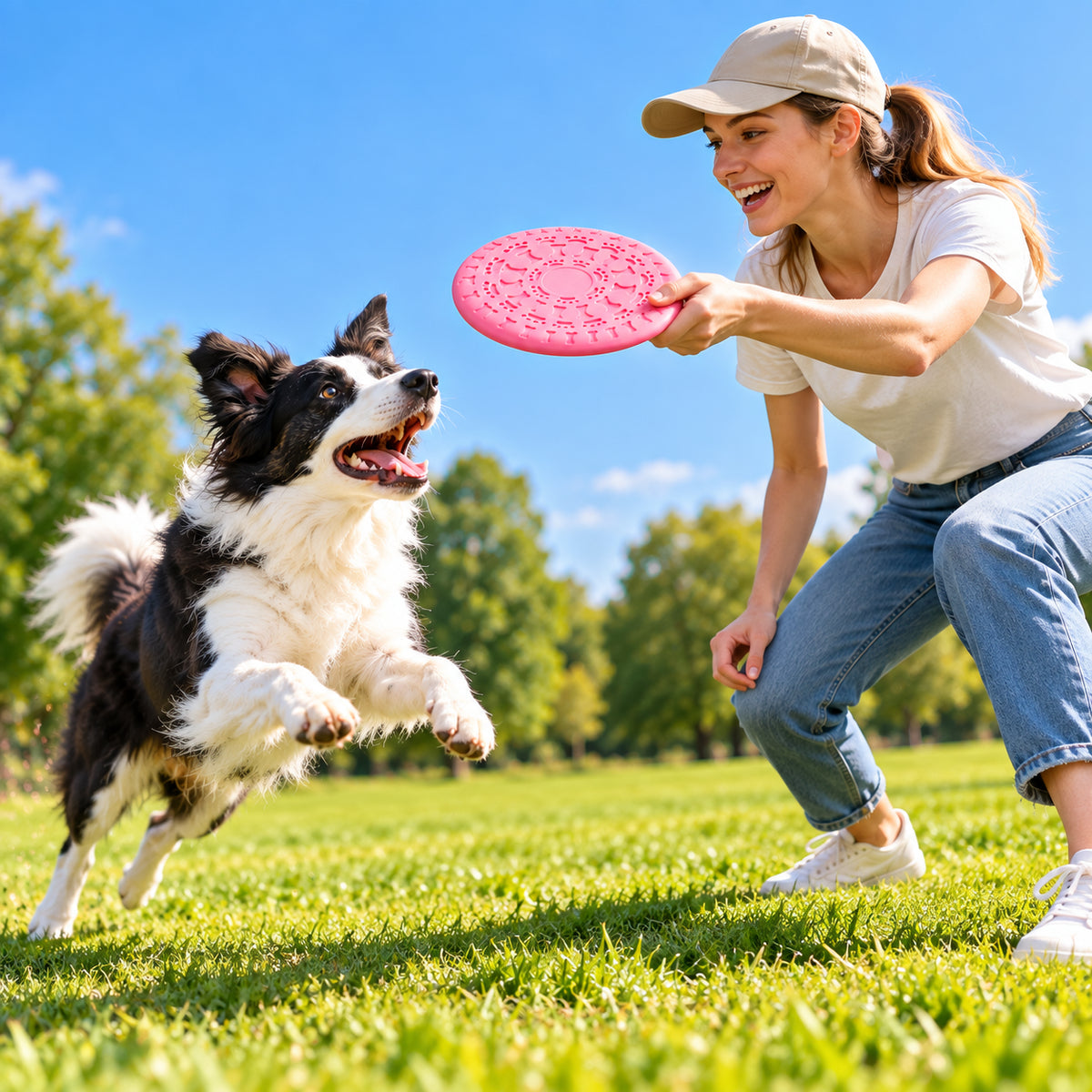
If your dog chases a flying disc with great enthusiasm and then refuses to bring it back, you are not doing anything wrong. The short answer is this: teach the return as its own skill, separate from the chase. Keep throws short, reward your dog for coming back to you with the disc, and use a simple trade or a second disc to make giving it up feel like a win, not a loss.
Most dogs do not refuse out of stubbornness. Chasing is exciting; running back and dropping a prized toy is much less exciting, unless we make it worthwhile.
Why Dogs Chase but Do Not Return
Think about the game from your dog's point of view. You throw the disc, your dog sprints after it, catches it, and feels proud. Then you ask for it back. If returning means the game ends, or the toy disappears into your pocket, why would your dog hurry back? Many dogs learn, quite sensibly, that keeping the disc keeps the fun going.
Start Close, and Reward the Return First
Begin in a garden, a quiet yard, or a hallway — somewhere with few distractions and a clear path back to you. Do not start with a full-power throw across a field. Roll the disc a short distance, or toss it gently just a few feet away. The moment your dog turns toward you, praise in a warm, upbeat voice. When your dog arrives, reward generously.
At this stage, the reward matters more than perfect form. A treat or a short tug game can both work. Coming back to you should pay better than running off with the disc. Repeat this short version many times before adding distance.
Use the Trade Game
The trade game is the kindest way to teach a reliable drop. When your dog comes back with the disc, offer a treat and say your usual cue, such as "drop" or "give," in a calm voice. When the disc leaves its mouth, give the treat right away — and then give the disc straight back. That last step matters. If your dog learns that dropping means losing the toy, it will hold on tighter next time. If dropping means a treat plus the toy again, giving it up becomes easy.
Once your dog drops happily, vary the reward: sometimes a treat, sometimes another throw. If your dog will not come close, do not chase it — that only teaches keep-away. Instead, crouch down and make yourself interesting.
Try the Two-Disc Game
If your dog loves to chase more than it loves treats, a second disc can be the best reward of all. Throw the first disc a short distance. When your dog picks it up, show the second disc and wave it invitingly. Most dogs will run back to chase the new disc, dropping the first one on the way. Throw the second disc, then repeat with the first. Your dog soon learns a simple rule: bringing one disc back is how the next throw happens.
Keep sessions short — ten minutes of happy practice is plenty — and stop while your dog is still keen.
A Disc That Fits Beginner Training
For this kind of short, repeated practice, a flexible disc is a forgiving choice for beginners. The OIKEIOS TPR Dog Flying Disc Toy for Fetch, Training & Treat Play is a 23 cm disc designed for fetch, training, and interactive play, and it comes in yellow, pink, and blue for $19.99. Its flexible TPR build suits the gentle, close-range throws this training uses, and a bright colour makes it easy for both of you to spot in grass.
Common Mistakes to Avoid
- Throwing too far, too soon. Distance is earned one successful return at a time.
- Ending the game the moment your dog returns. Always give a few more throws after a good return.
- Chasing your dog to get the disc back. This teaches keep-away, not recall.
- Practising only in exciting places. Master the return at home first, then try a quiet park.
Frequently Asked Questions
How long does it take to teach a dog to bring a disc back?
It varies a lot by dog, age, and experience. Many dogs improve noticeably within a few short sessions once the return is rewarded clearly, while others need a few weeks of steady practice. Short, regular sessions work better than one long session.
Should I use treats every time my dog returns?
At first, yes. Frequent rewards build a strong habit. As the return becomes reliable, you can vary the reward: sometimes a treat, sometimes another throw, sometimes praise and a quick game. Keeping rewards varied, but still frequent, usually keeps a dog keen.
What if my dog drops the disc halfway back?
Shorten the throw so the distance is easier, and reward any step toward you, even if the disc is dropped early. You can also run a few steps backward as your dog approaches, which often encourages it to follow you all the way in.
A reliable return is about trust: your dog learns that coming back always leads to something good. Start close, reward generously, and let the next throw be the prize.