
Yes, you can walk your dog safely after dark — with a light you can see by, a lead you can control in one hand, and a short routine you repeat every evening. Most night-walk problems come from the same three things: you cannot see where your dog is stepping, drivers cannot see either of you, and a loose lead leaves you with no quick way to bring your dog back to your side.
Light the ground in front of you
Darkness hides the small stuff: broken glass, uneven pavement, puddles, and anything your dog might try to eat off the ground. A light you carry in your hand beats a light clipped to your dog, because you can point it exactly where you need to look. Before you leave, check that the light works and that you can switch it on without fumbling. Walk on the side of the road that faces oncoming traffic where there is no pavement, and keep to well-lit streets whenever you have the choice. A familiar, lit route is always safer than a shortcut through a dark park.
Your dog should be visible too. Reflective gear helps drivers spot you both from a distance. If your dog wears a harness or collar with reflective trim, the light from a passing car catches it long before the headlights reach you. In winter, when it gets dark before dinner, this matters on every walk, not just late ones.
Keep control of the lead
A retractable lead is useful after dark because it gives your dog room to sniff and explore while you stay in charge of the distance. The trick is the lock. Practice locking and releasing the lead with your thumb before you need it in a hurry, so bringing your dog close becomes one quick movement, not a scramble. Lock the lead short whenever you cross a road, pass another dog, or walk past a driveway where a car could pull out.
Hold the handle firmly and keep your other hand free. Avoid wrapping the lead around your hand or wrist — if your dog lunges suddenly, a wrapped lead can injure your fingers. A comfortable, non-slip grip makes a real difference on cold or wet evenings, when a smooth handle is easy to drop. If your dog pulls hard, stop walking and wait for the lead to slacken before you move again. It is slower at first, but it teaches your dog that pulling never gets them where they want to go.
A simple evening walk routine
A routine keeps evening walks calm for both of you. Here is one that takes about twenty minutes:
- Before you go out: check the light, lock the lead short, and put a few waste bags in the holder so you are not caught without one.
- First five minutes: walk at a steady pace on a short lead and let your dog settle. This is the time most dogs are at their most excited.
- Middle ten minutes: let the lead out to a comfortable length on a quiet stretch, and let your dog sniff. Sniffing is tiring in a good way, and a dog that has sniffed its fill walks more calmly.
- Last five minutes: shorten the lead again, walk home on lit streets, and finish with a small treat or a drink of water. The same ending every night tells your dog the walk is over.
Carry the small things, all in one place
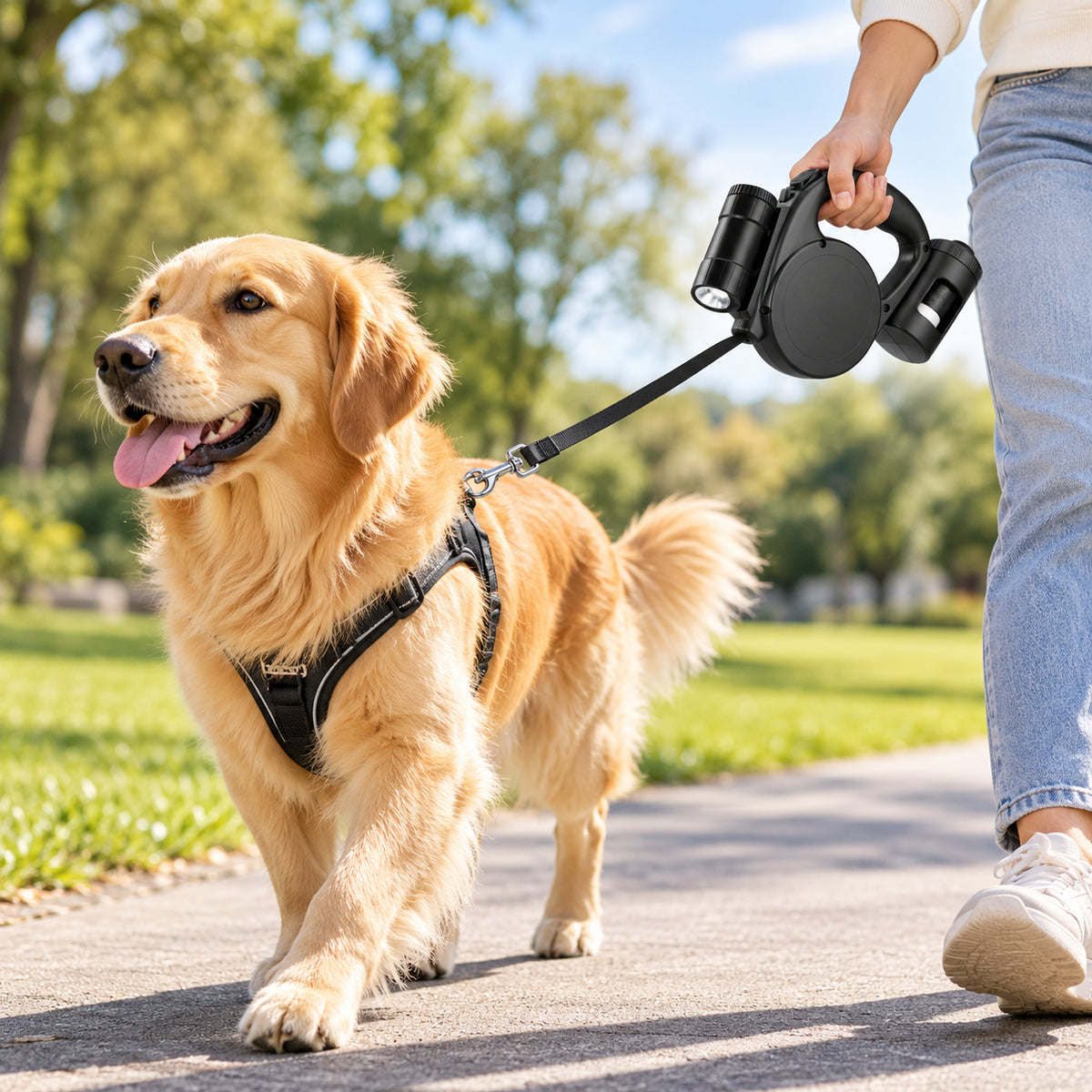
Evening walks go wrong most often over small missing items: no bags when your dog goes, no light when the street lamps end, no way to shorten the lead quickly. Keeping these together on the lead itself means you grab one thing on the way out and you have all three. The OIKEIOS 5m Retractable Dog Leash with Flashlight & Waste Bag Holder ($32.99) combines a 5-meter retractable lead with a one-touch lock, a built-in flashlight that runs on three AAA batteries, and a waste bag holder in one handle. It comes in seven colors, and the contoured anti-slip handle stays comfortable to hold on a cold evening.
Frequently asked questions
Is it safe to walk my dog at night?
Yes, for most dogs, as long as you stay on lit, familiar routes, keep your dog visible, and keep the lead short near roads. If your dog is nervous in the dark, start with short walks close to home and build up gradually.
How long should an evening walk be?
About twenty to thirty minutes suits most adult dogs. Puppies and older dogs usually need less. Watch your dog rather than the clock: slowing down, lagging behind, or heavy panting are signs to head home.
Should I use a retractable lead at night?
A retractable lead works well at night if you use the lock often. Keep it short near roads, driveways, and other dogs, and only let it out on quiet, open stretches where you can see clearly.
What should I do if my dog is scared of the dark?
Keep the walk short and the route familiar, speak calmly, and avoid forcing your dog toward things that frighten them. A steady routine and a familiar route usually help a nervous dog relax within a week or two. If the fear is strong or getting worse, ask your vet for advice.