
Short answer: Keep fetch short, easy to win, and a little bit surprising. For a dog that loses interest quickly, three to five short throws with a light, squeaky toy — followed by praise and a clear finish — will usually beat a long session of the same throw repeated over and over.
If your dog chases a toy once, drops it halfway back, and wanders off to sniff the fence, you do not have a lazy dog. Your dog probably got bored, tired, or confused. Fetch is a chain of skills — watch, chase, pick up, carry, and bring back — and if one link is too hard or dull, the game falls apart.
The fix is to rebuild that chain in small, winnable steps, with a light, visible, squeaky disc.
Why dogs lose interest in fetch
Most fetch games fail for one of four reasons: the session is too long; the throws are too hard, asking your dog to search rather than chase; the toy is hard to pick up from the ground; or nothing changes, and the same throw in the same place stops feeling like play.
When your dog slows down or starts sniffing instead of chasing, treat that as information, not disobedience. End on a good note and try a shorter version next time.
Start with short, easy wins
Begin in a quiet yard or empty corner of a park. Stand close and roll or toss the disc just a few feet away, so it lands in plain sight. When your dog picks it up, praise warmly and step backward, so coming toward you feels natural. If your dog drops it, walk calmly to it and try again with a shorter throw.
Keep the first sessions to about five minutes, with only three to five throws. That leaves your dog wanting one more throw — exactly the feeling you want to build.
Use sound and shape to hold attention
A squeak is useful when used sparingly. Give the disc a gentle squeeze before you throw it, so your dog connects the sound with the start of the game. If you squeak the toy constantly, the sound stops being special, so save it for the first throw, or for the moment your dog starts to drift.
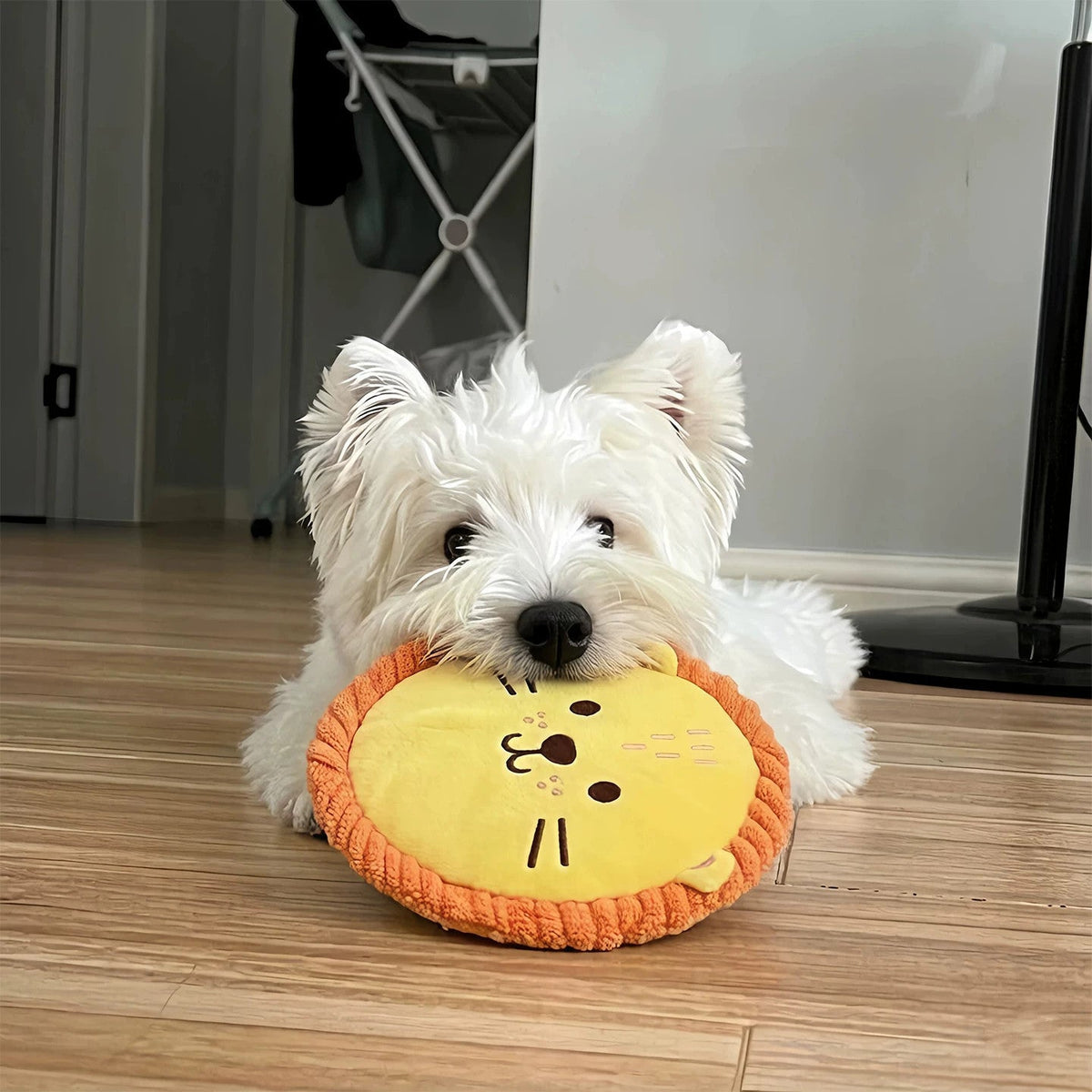
Shape matters too. An animal-shaped disc is easy to spot on grass and can be easier to mouth than a flat disc, turning a fumble into a successful pick-up.
A simple 10-minute fetch routine
Warm up (2 minutes). Let your dog sniff the disc, then roll it a short distance on the ground. Praise any interest, even if your dog only noses it or picks it up and drops it.
Play (5 minutes). Throw short, low tosses your dog can follow. Alternate throws with gentle rolls and change direction now and then. If your dog does not bring the toy back yet, walk to it together and celebrate the pick-up.
Wind down (3 minutes). End while your dog is still interested. Put the disc away, offer water, and take a slow walk around the yard. Ending early is not quitting; it is how you protect the game for tomorrow.
A toy that fits this kind of play
The OIKEIOS Animal Squeaky Flying Disc Dog Toy is made for this sort of short, interactive game. It comes in two character styles, Lion and Elephant, each weighing about 80 g, so it is light to toss and easy to carry. The Lion measures about 18.3 × 18.3 cm and the Elephant about 21.3 × 14.5 cm. It is priced at $18.99 and is designed for supervised play at home, in the yard, or at the park. As with any toy, check it regularly and replace it if it becomes damaged or if pieces become loose.
If your dog stops mid-session, make the game easier: shorten the throw, roll the disc, or move to a quieter spot. Fetch is a game you build together, one short, happy round at a time.
Frequently asked questions
How long should a fetch session last for a dog that loses interest?
Start with about five minutes and three to five throws. End while your dog is still keen, then build up slowly. A short, happy session teaches more than a long session that ends in boredom.
Should I keep throwing if my dog stops bringing the toy back?
No. If your dog stops returning the toy, the game has become too hard, too long, or too repetitive. Make the next throw shorter and easier, celebrate the pick-up, and end on a good note rather than pushing through.
Does a squeaky toy help with fetch?
For many dogs, yes, when used sparingly. A squeak before the throw can focus attention and mark the start of the game. Keep squeaky toys for play sessions and put them away afterward, so the sound stays special.
What if my dog only chases but never brings the toy back?
That is normal in the early stages. Reward the chase and the pick-up first, then practise short returns by stepping backward and praising every step toward you. A reliable return is built gradually, not demanded on the first day.