
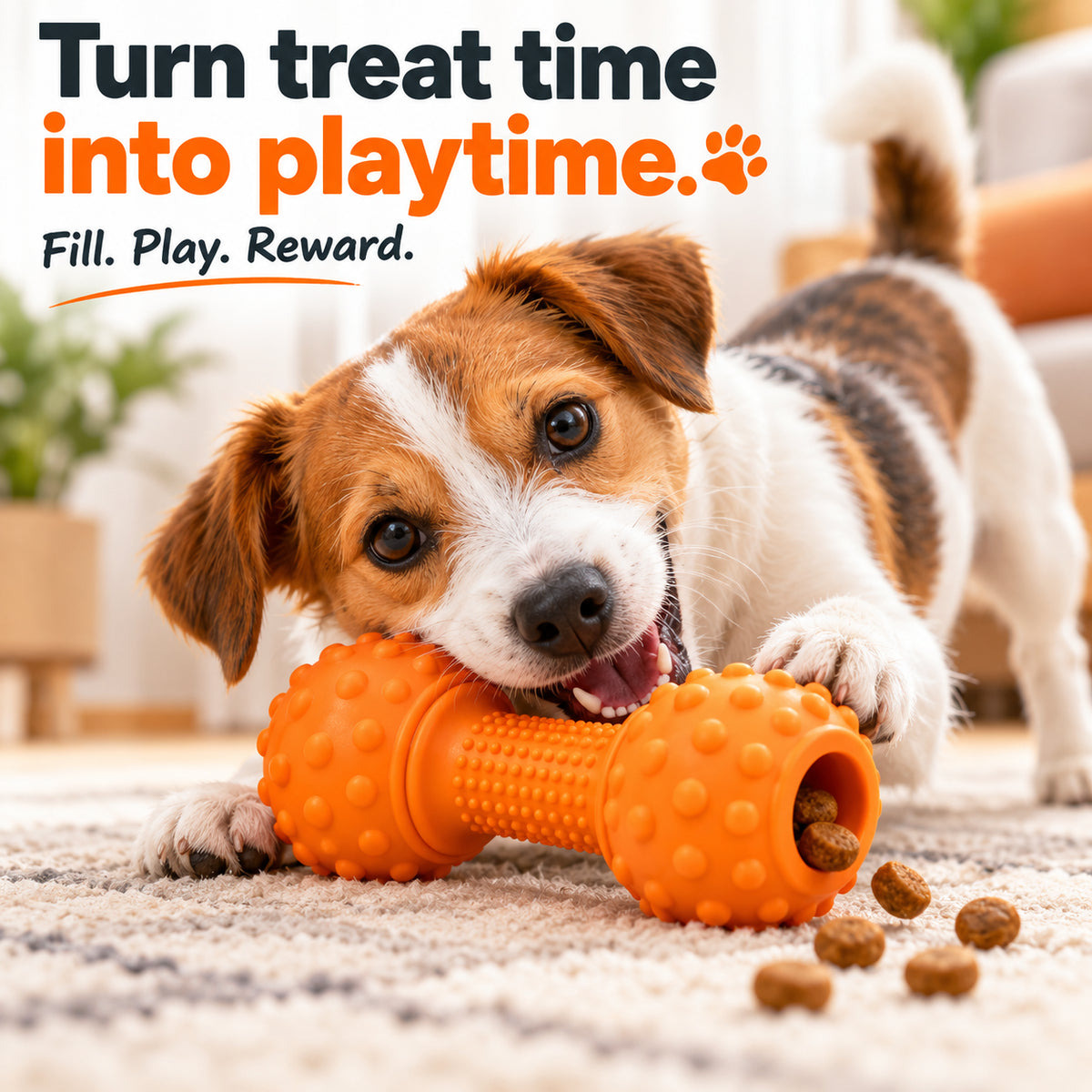
Short answer: The simplest way to keep your dog busy when you are out is to turn part of their daily food into a game: put a small portion of their regular kibble or small dry treats into a treat-dispensing toy, offer it in a short supervised session before you leave, and let your dog chew, nudge, and roll the toy to work for each reward. A dog that has to work for food is usually calmer and more settled than a dog that eats from a bowl in thirty seconds and then looks for something else to do.
Many dogs are not being naughty when they chew shoes or pace by the door. They are often under-stimulated. Dogs need both physical exercise and mental work, and a walk alone does not always use up their curiosity. Treat-dispensing toys fill that gap by asking a dog to solve a small problem: how do I get the next piece out?
Why a food game works better than a full bowl
When food comes from a bowl, there is nothing to figure out. When the same kibble comes from a toy, your dog has to sniff, paw, nudge, and chew, and each success delivers a tiny reward. That keeps the brain busy, slows down eating, and gives a dog a job to finish. Afterward, many dogs settle down for a nap instead of searching the house for entertainment.
Build a simple treat-dispensing routine
Start easy. On the first few days, fill only one end of the toy and use treats your dog already likes, so the reward comes quickly and your dog learns how the game works. If the toy is too hard at first, your dog may lose interest, so early wins matter more than a long challenge.
Next, use part of the daily ration instead of extra treats. Measure out your dog's normal food, set aside a small handful for the toy, and serve the rest as usual. This keeps the total amount of food about the same and avoids overfeeding. Small, dry treats or kibble work best, because soft or sticky fillings can clog the openings and make cleaning harder.
Keep sessions short and supervised, especially at the start. Ten to twenty minutes is plenty for most small and medium dogs. Watch how your dog plays, check the toy for wear, and take it away when the session ends. A toy that only appears at certain times stays interesting, and regular checks help you spot damage early.
Once your dog understands the game, make it slightly harder by using smaller kibble or placing the toy on a mat. If your dog gets frustrated, go back to the easier version for a day or two.
Choose a toy that fits your dog
Size matters more than color or shape. A treat-dispensing toy should be easy for your dog to carry and nudge, with openings large enough for the kibble you plan to use but small enough that the food does not fall straight out. The OIKEIOS Treat-Dispensing Dumbbell Chew Toy is made for small and medium dogs: it measures about 13 x 4.8 cm (5.1 x 1.9 in), weighs about 95 g (3.4 oz), and has hollow ends with openings of about 18 mm (0.7 in) for small treats or kibble. It is priced at $16.99 and comes in Orange, Green, Blue, Yellow, and Pink.
Always match the toy to your dog's size and chewing style, and supervise play. Inspect the toy regularly and stop using it if it becomes damaged or pieces begin to separate. This toy is not edible, so it should be treated as a play item, not a chew to eat.
Keep it clean and keep it interesting
Rinse the toy with water after use and let it dry completely before the next session. Rotation helps too: swap two or three different play options through the week, so no single toy becomes boring.
Frequently asked questions
How long should a treat-dispensing session last?
Ten to twenty minutes is a good starting point for most small and medium dogs. End the session while your dog is still interested, and offer the toy again the next day rather than leaving it out all day.
Can I use my dog's regular kibble in a treat-dispensing toy?
Yes, as long as the kibble fits through the openings. Using part of the daily ration is a simple way to add enrichment without adding extra calories. The OIKEIOS Treat-Dispensing Dumbbell Chew Toy has openings of about 18 mm, so small treats and kibble work best.
Should I leave a treat-dispensing toy with my dog when I go out?
Start with supervised sessions so you can see how your dog plays with it and check for wear. Once your dog uses it calmly and the toy stays in good condition, you can decide whether it suits your leaving routine.
What if my dog loses interest in the toy?
Make the game easier again, use higher-value treats for a few sessions, or take a break for a day and rotate in a different toy. Dogs often return to a toy with fresh interest after a short break, especially when the first rewards come quickly.
A busy dog is usually a calmer dog. Start with one short food game a day, use food your dog already eats, and build the habit slowly.