
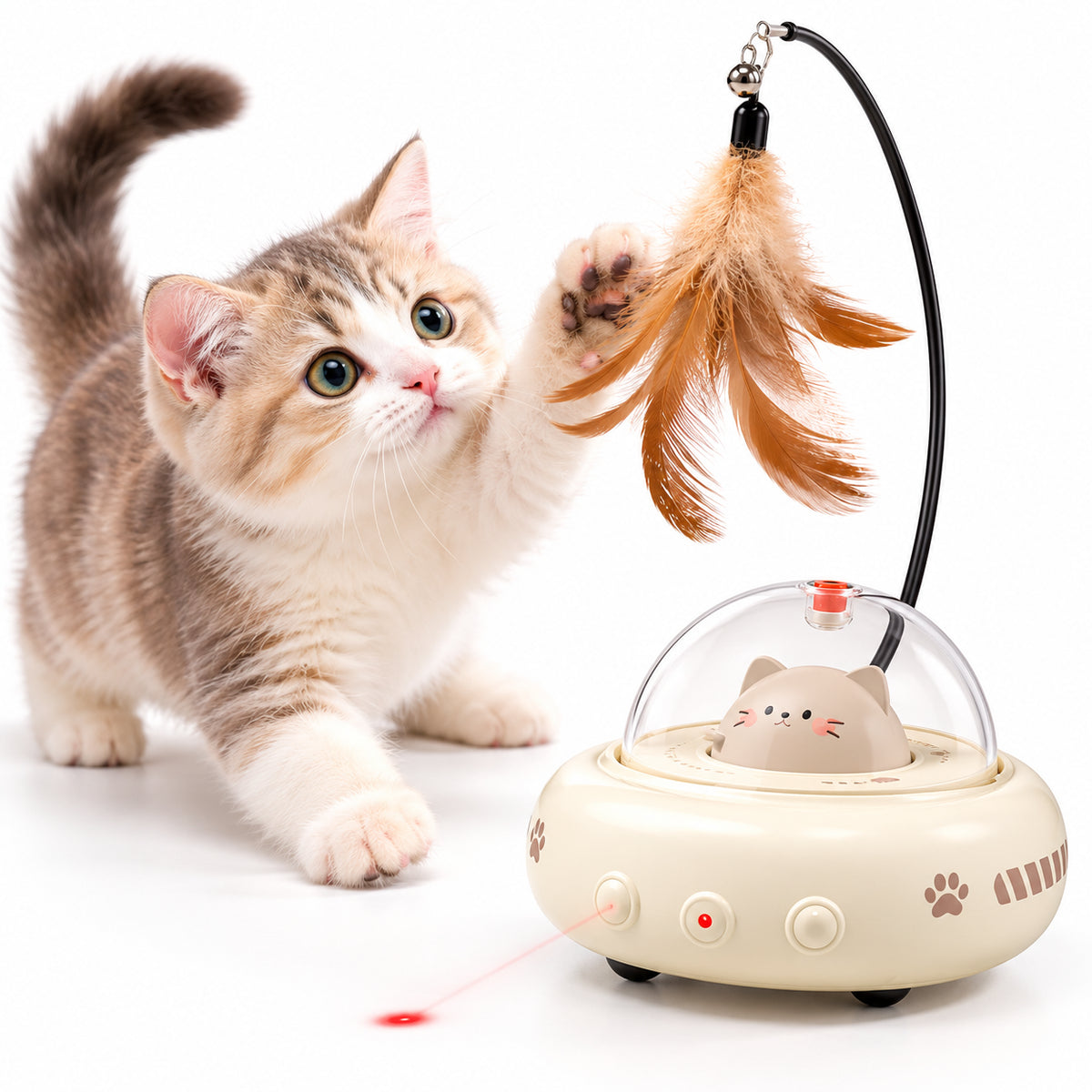
Yes — you can keep an indoor cat happy while you are at work. The trick is not one long play session but several short bursts of movement spread through the day: a moving toy that changes direction on its own, a window perch to watch the world, and a food puzzle that makes dinner feel like a hunt. Together, these give your cat the chase, the climb, and the puzzle-solving it would get outside, without you having to be in the room.
Why indoor cats get bored
Cats are hunters by nature. In the wild, a cat spends much of its day stalking, chasing, pouncing, and resting between hunts. An indoor cat has the same instincts but far less to hunt. When those instincts have nowhere to go, boredom shows up as restless pacing at night, knocking things off shelves, over-grooming, or sleeping far more than usual. The goal is not to wear your cat out — it is to give those hunting instincts a small, safe outlet a few times a day.
What actually keeps a cat engaged
Three things make play interesting to a cat: movement, unpredictability, and a payoff. A toy that sits still is ignored within minutes. A toy that moves in the same circle every time is figured out just as fast. What holds a cat's attention is a target that darts, pauses, changes direction, and sometimes disappears behind furniture — the same way real prey would.
Short sessions work best. Five to ten minutes of active chasing, followed by a rest, matches how cats naturally play. Two or three of these sessions a day — one before you leave, one in the evening — do far more than a single long session your cat will abandon halfway through.
A simple weekday routine for a working cat owner
Morning: five minutes of chase before you leave. Start the day with a moving toy or a feather wand session. Let your cat catch the toy at the end — a hunt that never ends in a catch is frustrating, not fun.
Midday: let the house do the entertaining. This is where an automatic toy earns its keep. The OIKEIOS Interactive Moving Cat Toy with Feather & Laser ($29.99) moves around the floor on its own, changes direction when it bumps into furniture, and pairs a feather wand with a built-in laser dot, so the chase pattern keeps changing while you are away. It goes into standby when play stops and wakes up again with a touch, so it is ready for the next burst of energy. Set it on a clear indoor floor, away from stairs and fragile objects, and your cat has a hunting partner for the afternoon.
Evening: a window and a puzzle. A window perch gives your cat birds, leaves, and passing people to watch — free entertainment that many cats prefer to any toy. Finish the day by serving part of dinner in a puzzle feeder or scattered across a mat, so the last meal of the day takes some work to find.
Rotate, don't accumulate
Cats lose interest in toys they see every day. Keep two or three toys in a drawer and swap them every few days. A toy that has been out of sight for a week feels new again. The same goes for the automatic toy: put it away for a day or two between uses and it will hold your cat's attention much longer.
A few safety notes
Always supervise play with feather attachments, especially if your cat chews or pulls hard — inspect the feather and wand regularly and stop using the toy if any part becomes loose or damaged. Never direct a laser toward your cat's eyes, and let your cat catch a physical toy at the end of a laser session so the game has a satisfying finish. Keep play on a clear floor, away from stairs, water, and anything breakable.
FAQ
How long can I leave my cat alone during the workday?
Most healthy adult cats are fine alone for a typical 8-hour workday if they have fresh water, food, a clean litter box, and something to do. Kittens and older cats need more frequent check-ins.
Is it cruel to keep a cat indoors all day?
Not if the indoor environment meets the cat's needs: places to climb and perch, a window to watch from, scratching surfaces, and regular play. Indoor cats live longer on average because they avoid traffic, predators, and disease — boredom, not the walls, is the real problem.
Why does my cat ignore expensive toys?
Because cats are drawn to movement and novelty, not price tags. A toy that moves unpredictably and disappears for a while will beat a beautiful toy that sits still every time. Rotate toys and let the cat win the catch.
Do automatic cat toys really work when nobody is home?
They work best as one part of the day, not the whole plan. An automatic moving toy gives your cat chase and pounce practice in the afternoon, but it should sit alongside a morning play session with you, a window perch, and a food puzzle — together, they cover the whole hunting cycle.