
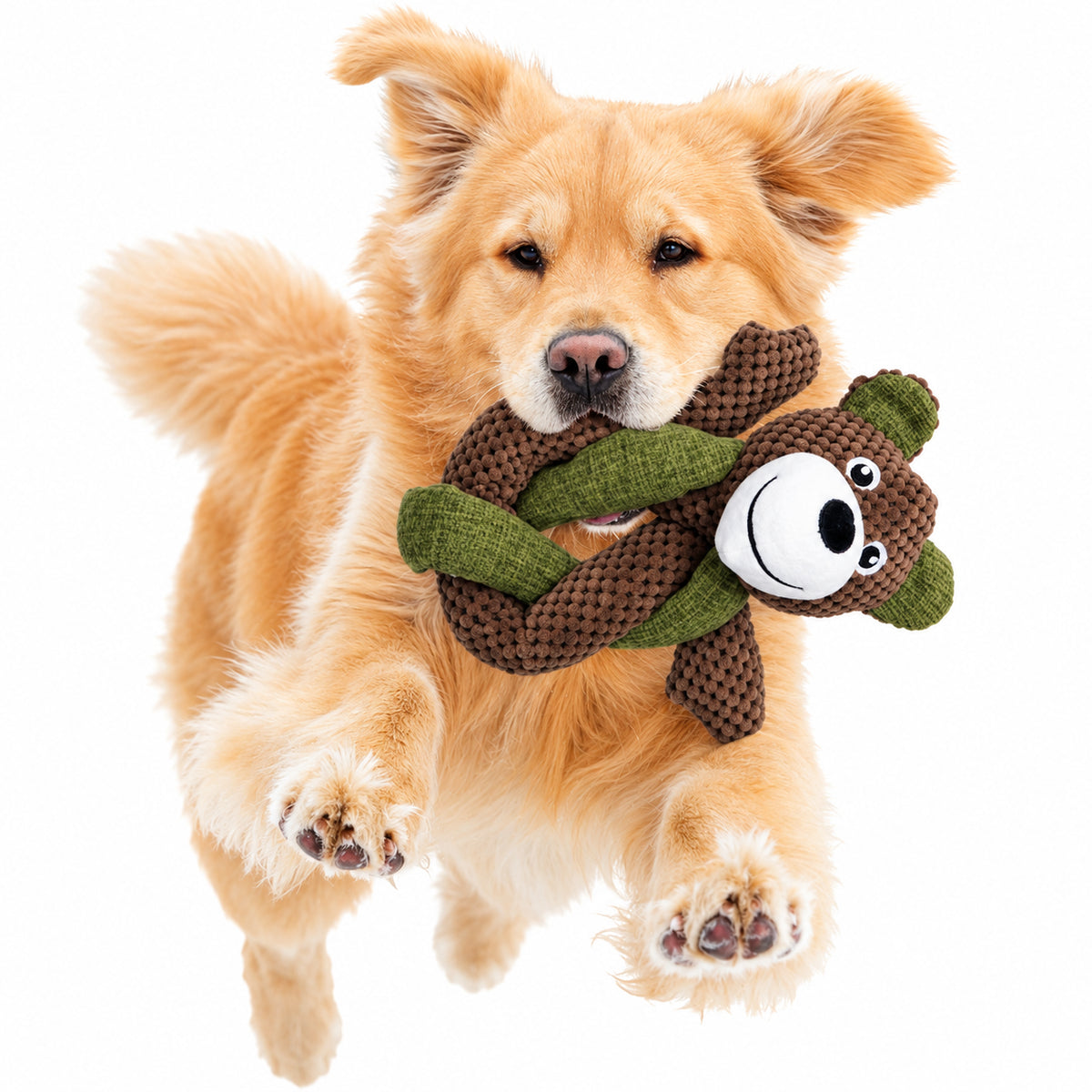
If your dog ignores a whole basket of toys and always goes back to the same one, the answer is usually simple: that toy feels, sounds, and moves the way your dog likes to play. Texture, squeak, shape, and weight all matter, and when they line up, a toy becomes a favourite instead of just another thing on the floor.
Most of us have seen it at home. You buy three new toys, tidy them into the basket, and by evening one is on the sofa, one is under the table, and one is already forgotten behind the door. It is not fussiness for fun. Dogs explore the world with their mouths, so the feel of a toy is information to them in a way it is not to us.
Why texture comes first
Think about how different a smooth ball feels compared with a soft, nubby fabric toy. One slides, one grips. One is easy to hold, the other invites mouthing, nosing, and carrying. A mix of textures gives a dog more to notice: a soft rabbit-fur-style patch here, a sturdier linen-like section there, a floppy ear or leg that moves when the toy is shaken.
Sound adds interest, but it should not do all the work
A squeak is a quick reward. Your dog squeezes, something happens, and the game feels alive. The trick is to treat sound as a bonus, not the whole point. If a toy only matters while it squeaks, play can turn frantic, and the toy may get chewed hard in an attempt to find the noise.
Try this instead: use the squeak to start the game, then keep the game moving. Toss it a short distance, ask for it back, trade it for a treat, and toss it again. Short, happy rounds beat one long, overexcited session, and they help your dog learn that play is something you do together.
Shape and size change how a dog plays
Shape decides whether a toy is carried, tossed, nosed, or cuddled. A long, floppy shape is easy to grab and shake. A round, compact shape is easier to push around the floor. A toy with legs, ears, or tentacles gives a dog different places to hold, which is part of the fun.
Size matters just as much. A toy should be easy for your dog to pick up and carry without dragging on the floor. If you are choosing between characters, look at the measurements as well as the picture: the Bear style measures 27 x 24 x 10 cm and weighs 180 g, while the Rabbit-Fur & Linen Rabbit is longer at 60 x 25 x 6 cm, also 180 g. A smaller dog may do better with a compact shape, while a larger dog may enjoy a longer toy they can really get hold of.
A simple three-toy test you can try at home
You do not need a shelf full of toys to learn what your dog likes. Put out three different toys for a few days and watch, without steering the choice. Offer each one for a short session, then put it away. Notice which one your dog picks up first, carries around, or brings back to you, and which one gets left alone after the first sniff. That little test tells you more than any label can.
Keep favourite-toy play safe and lasting
No dog toy is indestructible, and a favourite toy deserves a quick check, not blind trust. Play with textured and squeaky toys under supervision, and inspect them regularly for torn seams, loose parts, or stuffing starting to come out. If a toy is torn or pieces begin to separate, take it away and replace it. That rule matters most for enthusiastic chewers, who can turn a gentle carry toy into a chew toy in minutes.
If you want a textured, squeaky option to try the test with, the OIKEIOS Textured Squeaky Animal Dog Toy for Interactive Play is $19.99 and comes in eight animal characters, including a sloth, rabbit, bear, frog, octopus, and yellow chick, in soft rabbit-fur-style and linen-like fabrics. It is made for supervised carrying, tossing, and interactive play, so it fits the short, shared game described above rather than unsupervised chewing.
Frequently asked questions
Why does my dog only like one toy?
Usually because that toy matches how your dog likes to play. The right texture, a rewarding squeak, and a shape that is easy to carry can make one toy stand out from everything else in the basket.
Are textured toys better than smooth toys?
Not for every dog, but many dogs find texture more interesting to mouth and carry. The best way to know is to offer both kinds for short sessions and see which one your dog returns to.
Should I let my dog chew a squeaky toy unsupervised?
No. Squeaky and textured plush-style toys are for supervised interactive play. Check them often, and remove any toy that is torn or coming apart.
How do I choose the right size?
Pick a toy your dog can pick up and carry comfortably. Check the listed measurements for the character you like, and avoid a toy so small that it is awkward to mouth or so large that it drags and trips your dog.