
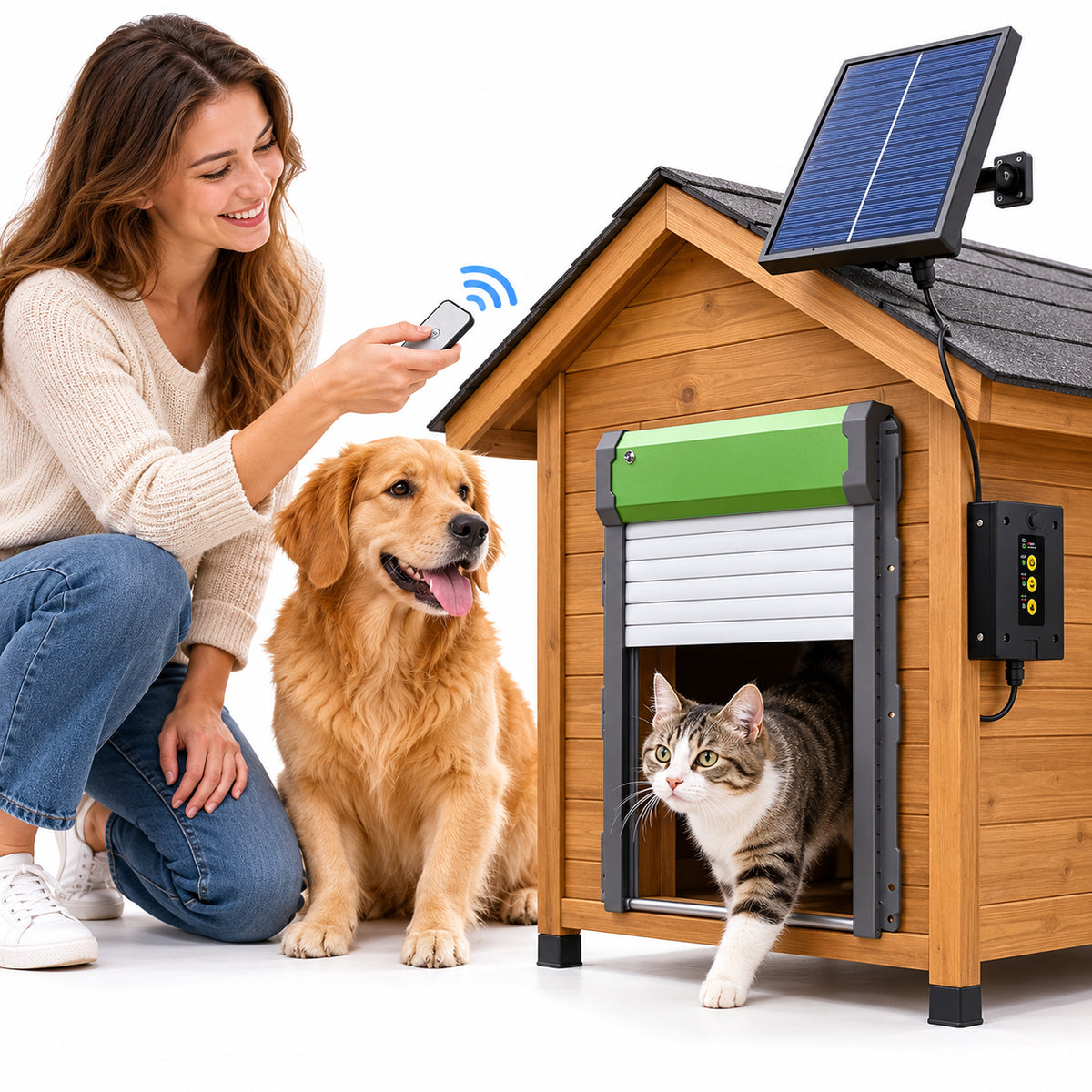
Short answer: An automatic pet door can be a good fit for a cat or small dog if the opening fits your pet, the door is installed where it can be used safely, and you introduce it gradually. The best choice is not the most automatic setting, but the mode that matches your daily routine: a timer for a regular schedule, a light sensor for daylight-based coming and going, a remote when you want control from a distance, or manual control when you want to decide each time.
Many pet owners first think about an automatic door because of one small daily friction. The cat waits by the door at dawn. The small dog needs to go out while you are busy in another room. Someone has to get up, open the door, wait, and close it again. A door that opens on a schedule or with daylight can smooth out that routine, but only if it is set up with your pet's size, habits, and home in mind.
Start with size, not features
Before comparing modes, measure two things: your pet and the opening where the door will go. Pet fit depends on the individual animal's body dimensions, not on breed alone, so measure shoulder height, body width, and how comfortably your pet can step through. Then compare those measurements with the opening itself.
For reference, the OIKEIOS door listed below has a product size of approximately 37 x 30 x 10 cm, with a supplier-shown door opening of approximately 10.8 x 9.4 in (27.4 x 23.9 cm). That size is designed for cats and appropriately sized small dogs, and it can also suit chicken coops and similar small-animal enclosures where the opening dimensions are appropriate. If your pet is close to the limit, do not guess. A door that is too tight can make a pet hesitate, duck awkwardly, or avoid the door altogether.
Also think about placement. An outdoor door should be installed on a stable surface, following the supplied instructions, with the track kept clear. Check the door, tracks, power connections, and safety operation regularly, especially after wind, rain, or a lot of use.
The four control modes, in plain terms
Light sensor mode opens and closes based on daylight conditions. This can suit pets that naturally follow a day-and-night rhythm, such as a cat that likes to go out in the morning and settle inside at dusk. The trade-off is that daylight changes with the seasons, so the times will shift through the year.
Timer mode lets you set scheduled opening and closing times. This is often the most predictable option for households with a steady routine. If your dog goes out after breakfast and comes in before bedtime, a timer can keep that pattern consistent even when you are not standing by the door.
Remote control mode lets you operate the door from a distance. The supplier information for the door below specifies an approximate range of 30 to 40 metres. This can be handy when you are in the garden or another part of the house, but it still works best as part of a routine, not as a replacement for checking on your pet.
Manual mode lets you operate the door directly from the control panel. This is useful during training, on unusual days, or whenever you want full control over each opening and closing.
Try one mode at a time. Switching between modes every day can confuse a pet that is still learning, while a steady routine helps them understand when the door will move and when it will stay put.
Solar power and outdoor use
A solar-powered door is designed to reduce the need for mains wiring outdoors. The door below lists a solar charging specification of 5V 280mA and a DC operating system of 3.7 to 5V output with a 5V power interface. Supplier materials describe the unit as waterproof and suitable for outdoor installation, and it uses a rolling-door design with an operating status indicator.
Even so, placement matters. A solar panel needs a reasonable amount of daylight to charge, so avoid a spot that is shaded all day. Keep the panel and the track clean, and check after storms or heavy dust. If the door ever behaves differently than usual, switch to manual mode and inspect it before returning to automatic operation.
How to introduce the door without rushing your pet
Most pets do not need to be forced through a new door. A slower introduction usually works better:
- Let them investigate first. With the door in manual mode and held open if possible, let your pet sniff and walk near it without pressure.
- Reward calm steps. Use a treat, a toy, or praise when your pet approaches or steps through willingly. Keep sessions short and relaxed.
- Close the loop gradually. Once your pet is comfortable, let the door move through its normal motion while you stay nearby, then try short automatic sessions.
- Watch the first week. Notice whether your pet hesitates, rushes, or tries to squeeze through at the last moment. Adjust the timing or mode if needed.
One safety feature worth understanding is anti-pinch protection. On the door below, if the closing door encounters an obstacle, it reverses and attempts to close again after approximately 3 seconds. That is a helpful safeguard, but it does not replace supervision during training or regular checks of the track and closing path.
A practical choice for cats and small dogs
If the size fits and the location works, the OIKEIOS Solar Automatic Pet Door for Cats & Small Dogs ($129.99) brings those four modes together in one unit: light sensor, timer, remote, and manual control, with anti-pinch protection and solar charging for outdoor use. It is a practical option for a household that wants a steady routine without running power to an outdoor shelter or coop.
Whatever door you choose, keep the goal simple: a door your pet trusts, on a schedule you can predict, in a place you can check easily. That combination matters more than any single feature.
Frequently asked questions
Is an automatic pet door safe for a cat or small dog?
It can be, when the opening fits your pet, the door is installed according to its instructions, and the track and closing path are kept clear. Introduce the door gradually, supervise early sessions, and inspect the door, tracks, power connections, and safety operation regularly.
Which mode is best: timer or light sensor?
Choose a timer if your household follows a regular schedule and you want the same times every day. Choose a light sensor if your pet's routine follows daylight more than the clock. Many owners start with a timer for predictability, then try the light sensor once the pet is confident with the door.
How do I know if my pet will fit?
Measure your pet's body dimensions and compare them with the door opening, not just with a breed label. For the door above, the supplier-shown opening is approximately 27.4 x 23.9 cm. If your pet is close to that size, test with a cardboard opening of the same dimensions before installing.
What if my pet is afraid of the moving door?
Slow down. Return to manual mode, reward calm approaches, keep sessions short, and let your pet set the pace. If fear continues, pause automatic use and try again later. A pet that trusts the door will use it far more reliably than one that was rushed through it.